How a Career-Orientation Provider in Brandenburg Turns Classroom Feedback Into App Features the Same Day
Two AI-native student apps, built in short cycles, with classroom feedback reaching the live apps the same day.
Client snapshot
JobFire.works runs career-orientation workshops in schools around Fürstenwalde/Spree in Brandenburg and works with employers in the region. Its students are 14 to 20 years old, and many of them are about to look for their first training place. Christian Sternicke is the founder and managing director of JobFire.works. Marc Leberecht-Schneider shaped the apps as product owner and tested them with students in class.
The situation before
Job ads in the region are written for adults. In a workshop, a student reads "Mechatroniker" or "Fachverkäufer im Lebensmittelhandwerk" and has no picture of the work behind it. The job and company data that exists is spread over several public portals, each with its own format, and many postings carry no description at all.
The workshops also had a fixed date. JobFire.works needed tools that students could open on their own phones, in a classroom, for the project weeks starting on 28 September 2026.
Why they acted, and why now
JobFire.works had tried to build the apps with a previous service provider, but progress stalled: the technology stack, the framework and the developer resources on hand could not move fast enough to have something working before the first school workshops. The project weeks gave a fixed date, so JobFire.works needed a team that could ship tools students could use in the classroom by then.
Goals & success criteria
- 1Students find companies that fit their values, not only by job title.
- 2Students who don't have a CV with them can still leave the workshop with an application document.
- 3Feedback from each workshop reaches the apps before the next one.
- 4No student accounts and no database: answers stay on the student's phone and only leave it for the AI-assisted steps or when the student sends them.
What we did
Two web apps, designed and built AI-native with Claude Code, with Marc testing every round with students.
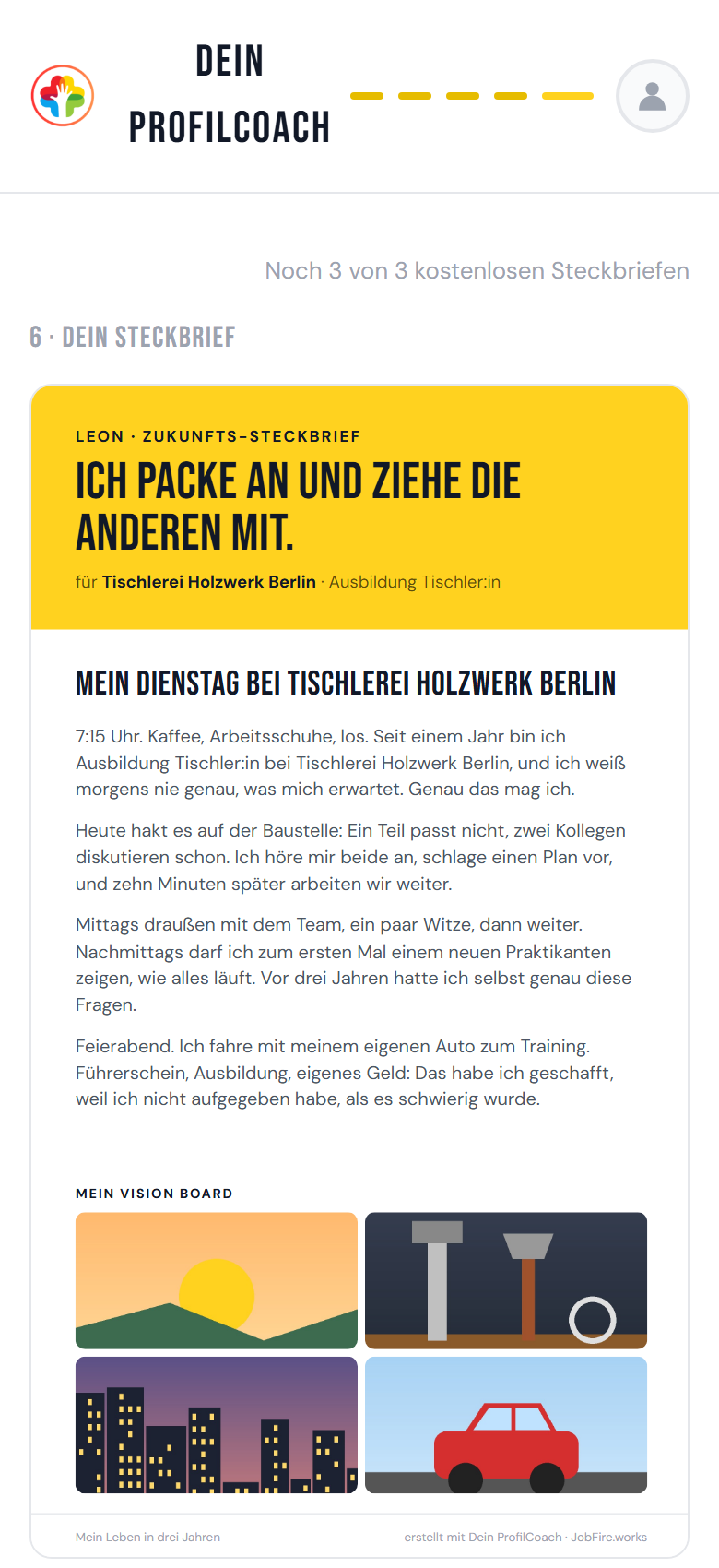
Dating app (live since May 2026). Students choose between two paths. The classic path analyses a CV and cover letter and tailors them to a job. The "Meine Story" path turns a student's answers into a short story in one of four formats, adds their photo and a vision board, and produces an A4 Steckbrief they receive by email.
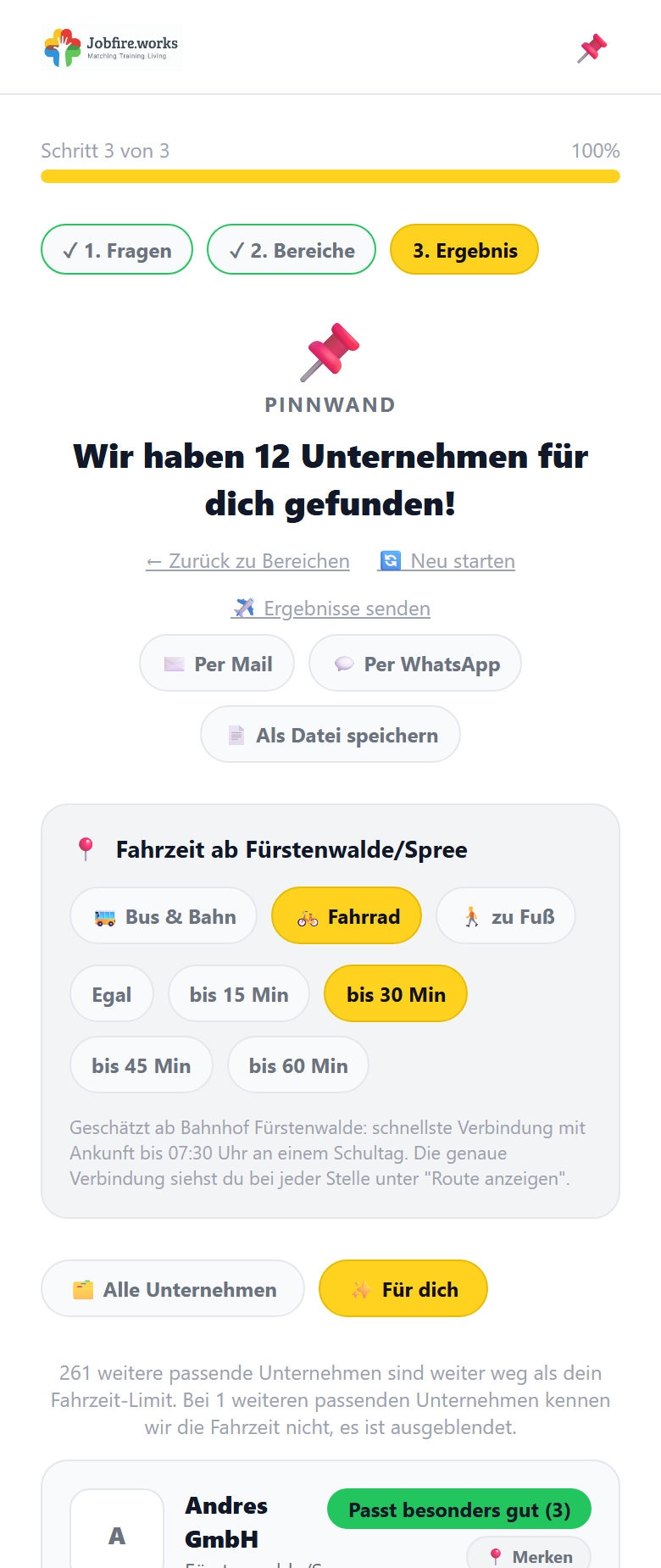
Matching app (first build on 24 and 25 July 2026). Students answer a short Wertecheck about character, situations and values, pick the fields they are interested in, and get a Pinnwand of companies that share their values. Matching follows fixed rules, without AI at runtime, so every match can be explained. When a student wants more, they can request a Talent Guide, and that request reaches JobFire.works by email.
The hardest part was the data. Two regional sources, with 352 and 337 postings, had to be merged. 61 postings appeared in both sources and were kept once, and 8 further duplicates were removed, leaving 620 postings; 440 company records became 384 companies. Where a dropped duplicate had the better description, it was carried over to the copy that was kept. The source data was incomplete in many places, so it took several sources, manual corrections and many test runs. Marc supplied the values taxonomy and the tagging rules; 286 companies were then tagged by hand.
Both apps were frozen on Saturday 27 September, two days before the first project week.
Results
Since October 2026, the apps have been in a workshop every week, each with a class of 15 to 20 students, and the schedule continues through the rest of the year.
On the morning of 1 October, Marc reported from three days with students. Students needed to know how long the trip to a company takes, not only how far it is: a job 40 km away can mean two and a half hours on public transport. They did not understand what the "Talent Guide" button did. Some asked for support before they had done the Wertecheck. By the evening of the same day, the Matching app had a travel-time filter (bus and train, bike, walking), an explanation of the Talent Guide option, and a prompt to do the Wertecheck first. Four days later, students could copy their results with one tap, and returning students were led back to their Pinnwand.
The Steckbrief path worked for students who had no application documents with them. One student refused to take part at first. A classmate offered to build his Steckbrief with him; over the next quarter of an hour he joined in, and at the end he asked to keep the printed poster.
Client voice
"The students loved it."
Marc Leberecht-Schneider, Product Owner, JobFire.works
How we worked together
Marc and Andreas met in recorded working sessions, several times a week before the launch (17, 21, 22 and 25 September). Marc brought feedback from the classroom; Andreas turned it into the next version, on 1 October within the same day. The working rhythm came from user-centred design and agile development: test with the people who use the tool, write down what they say, change the next version.
Why this worked
- A product owner who was in the classroom with the students every week.
- A fixed date that forced decisions: a freeze before launch, then fixes only.
- Small, rule-based features that can change in hours, backed by automated tests and a live check of both apps.
Who this is for
Education and career-orientation providers, associations and schools with a clear idea for a digital tool, access to their users, and no development team of their own.
Frequently asked questions
How long did the first version take?
The first Matching prototype took about five hours of recorded build sessions on 24 and 25 July 2026. Both apps were ready for classroom use by 27 September 2026.
Where is student data stored?
On the student's phone. Neither app has student accounts or a database. A student sends results or a support request only when they choose to. For the Dating app's AI features, text goes to Anthropic's Claude API for analysis and story writing, and a student's photo goes to Google's Gemini API only for the optional aging-photo feature. Both run on paid API access, where the providers' standard terms say prompts and files are not used to train their models.
Does the matching use AI?
No. Matching uses fixed rules on hand-tagged company profiles, so every result can be explained. AI is used in the Dating app to write the story and analyse documents.
Can the apps run for another organisation?
Yes. Each app runs as several branded instances from one codebase, with its own name, design and email settings.
If you run workshops or programmes and want to test a tool with your participants within weeks, let's talk.
Prefer email? andreas@mindfulai.academy